
Before a single car clears Japanese customs, it's already been judged. The auction sheet — filled out by an independent inspector at the lane — is the closest thing to a standardized truth document this industry has. It tells you the grade, the damage, the history, the mileage confidence, and the equipment. Knowing how to read one is the difference between a great buy and an expensive lesson.
The challenge is that every auction network prints its own sheet. CAA, HAA/JAA, USS, ARAI — they each have slightly different layouts, different abbreviation conventions, and different visual styles. The core logic is the same, but the details move around. This guide covers the universal framework first, then walks through what's different across the major networks.
The Grade System
The auction grade is the single most important number on the sheet. It's assigned by the inspector at the auction house and reflects the overall condition of the vehicle — exterior, interior, and history combined. Here's what each grade actually means on the ground:
| Grade | What It Means |
|---|---|
| S / 6 | Less than 12 months from first registration. Immaculate inside and out — as close to new as you'll find at auction. |
| 5 | Near perfect. Very minor imperfections if any. A difficult grade to achieve and immediately trustworthy. |
| 4.5 | Very high confidence. May have very slight bodywork imperfections. Mileage will be higher than a Grade 5. |
| 4 | Above average. Small scratches or dents may be present. Often comes with maintenance records. Minor repairs only if needed at all. |
| 3.5 | The most common auction grade. Condition range is wide — a 3.5 can be great or just passable. Pre-bid inspection strongly recommended. |
| RA | Minor accident damage that has been repaired well. Overall condition can be as good as 4.5. Worth inspecting. |
| 3 | Noticeable large scratches, paint blemishes, and/or large dents. Interior may show tears, burns, or stains. Body and interior work required. |
| R | Accident history — damage may or may not have been repaired. Condition range is wide. Commonly associated with drift and rally cars. Inspect before bidding. |
| 2 | Vehicle has corrosion holes. Structural integrity is a concern. |
| *** / 0 / 無効 / Blank | Not inspected, major accident, non-runner, or buy-as-is. Could be anything from an extremely old car to a flood vehicle. Always get an inspection on these. |
A Grade 3.5 on a kei truck with verified AC and 4WD is often a better buy than a Grade 4 without those features. The grade reflects cosmetic condition — not spec, not desirability, not long-term reliability. Read it alongside everything else on the sheet, never in isolation.
For grades R and below, a pre-bid inspection isn't optional — it's the only way to know what you're actually buying. We can arrange third-party inspections at the lane on your behalf.
Exterior & Interior Sub-Grades
Beneath the main auction grade, most sheets include separate sub-grades for the exterior and interior. These run on two parallel scales: numbers (5 through 1) and letters (A through E). In both cases, the top of the scale is best — 5 and A represent the cleanest condition.
So a car graded 4 / 外4 / 内B has a Grade 4 overall, a numeric exterior sub-grade of 4, and a letter interior sub-grade of B — slightly worn cabin but solid exterior. These sub-grades give you more resolution than the main grade alone, especially when shopping for interior-sensitive purchases like daily drivers or resale units.
Reading the Damage Map
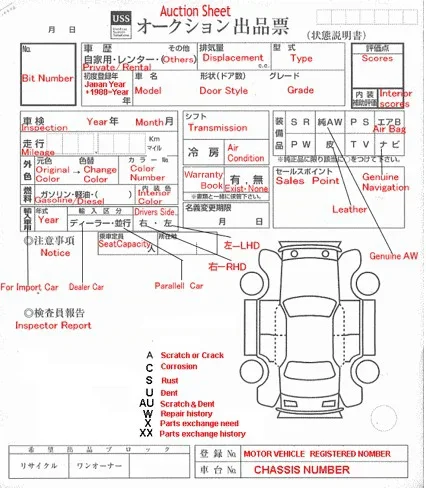
The body diagram — a top-down outline of the vehicle — is where the inspector marks every individual defect they find. Each mark corresponds to a damage code and a size code. Once you know the vocabulary, the map tells you exactly what needs attention and where.
Surface-level scratch including line scratches. Paintwork only. Often polishable.
A dent in the panel. Sized by U1 (thumb), U2 (palm), U3 (larger than palm).
Panel has been repaired. W1 = good repair, W2 = slight wave, W3 = conspicuous wave.
Dent that requires panel beating to fix. More involved than a simple U mark.
Multiple small dents, barely visible. Often from parking lot contact or hail.
Panel is too damaged to repair — needs full replacement. Budget accordingly.
Panel has already been replaced. May indicate prior accident work — check history.
S1/S2 = surface rust. C1/C2 = major corrosion. Sized from fist (1) to larger (2).
Panel discoloration or fading. Includes minor repaint artifacts.
Tear in interior material. Y1 (thumb), Y2 (palm), Y3 (larger).
When you see these codes plotted on the body diagram, think of them as a repair estimate sketch. A cluster of A marks along the driver's door? Light polishing. An X on the rear quarter with a W2 on the trunk lid? That's body shop time. An S2 anywhere near the sills or undercarriage? Dig deeper.
Mileage — And When Not to Trust It
Mileage on Japanese auction sheets is listed in kilometers. Most sheets express it in ten-thousand-kilometer increments (万 km), so a reading of 8.5 means 85,000 km. To convert to miles, multiply by 0.621 — so 85,000 km is roughly 52,800 miles.
Where it gets complicated: if you see a # / $ / * symbol next to the mileage, the auction house is explicitly not confirming the odometer reading. This could be because the vehicle has a 5-digit odometer that has rolled over, because there's evidence of an odometer swap, or simply because the car is too old to verify. Many of these vehicles have accurate clocks — it's often a formality — but you should have your broker confirm before bidding.
Separate from the audit flag: if the sheet or notes include 走行不明 (mileage unknown) or メーター交換 (odometer replaced/swapped), that's a different situation entirely. Those are hard stops. Unknown mileage and confirmed odometer tampering kill valuation and create trust issues that can't be unwound at the point of sale in the US market.
Registration dates on auction sheets are often written in the Japanese imperial era format. Showa (S) years start from 1926 — so S60 is 1985. Heisei (H) starts from 1989 — H9 is 1997, H15 is 2003. Reiwa (R) began in 2019 — R5 is 2023. If you see a first registration listed as H7, that's a 1995 vehicle. The era conversion matters when you're calculating 25-year import eligibility.
Equipment Abbreviations
The feature list on an auction sheet tells you what came on the car from the factory — and what's been confirmed present at inspection. Equipment is circled if genuine/factory-installed. Here are the most common codes you'll see:
On kei trucks specifically, AC and 4WD are hard requirements for most US buyers — both for practical use and resale value. When you're scanning sheets, confirm both are circled as genuine equipment, not just listed in the sales points. "Listed" and "confirmed present" are different things on an auction sheet.
The Major Auction Networks
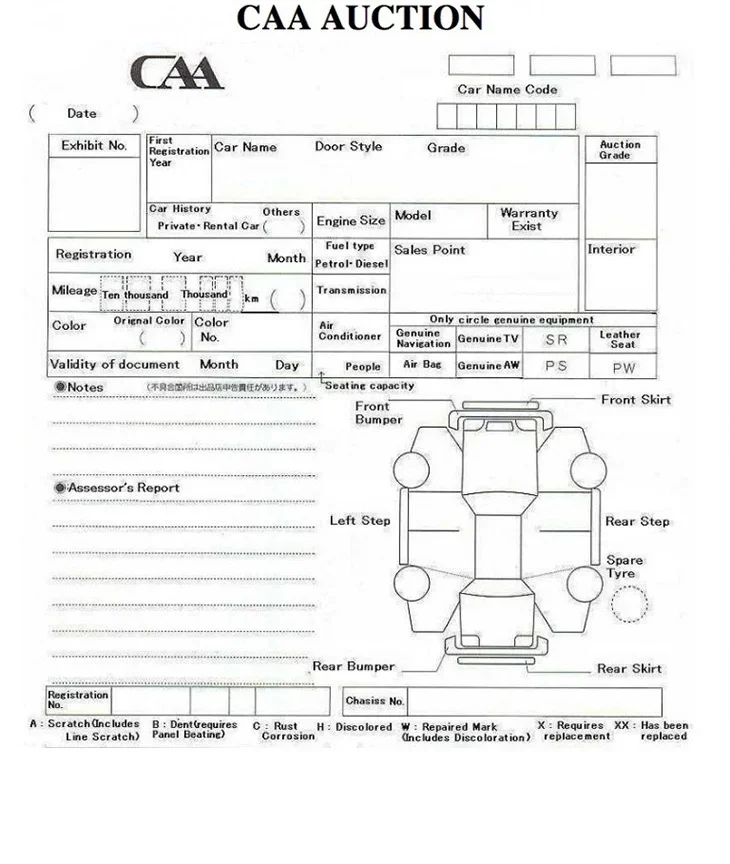
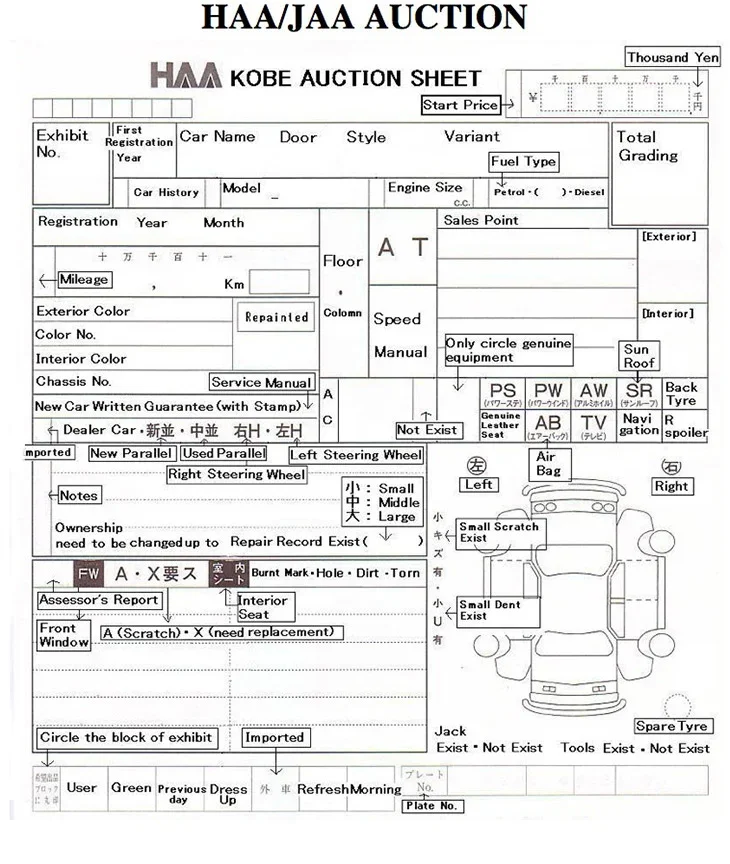
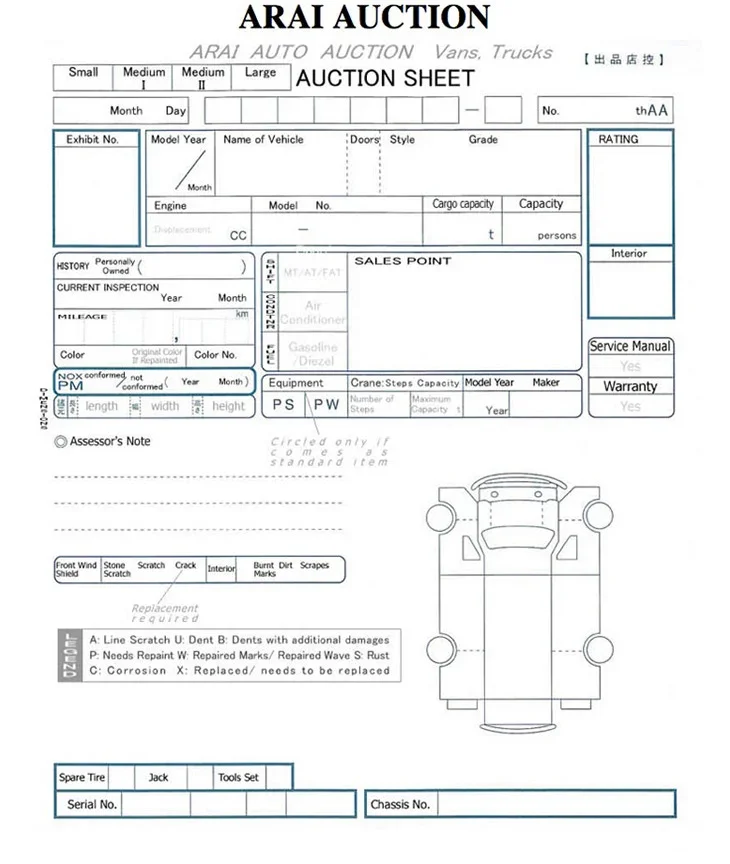
The grading logic is universal — the sheet format is not. Here's a quick overview of the four networks whose sheets are most commonly encountered when sourcing JDM vehicles:
- Full top-down body diagram
- Exterior + Interior sub-grades
- Detailed assessor's report section
- Equipment circled if genuine
- Mileage unconfirmed flagged with # / $ / *
- Clean top-down diagram with labeled panels
- Car History field (Private / Rental)
- Fuel type noted (Petrol / Diesel)
- Equipment circled as genuine
- Separate Assessor's Report section
- Separate Small Scratch and Small Dent indicators
- Repair Record Exist field
- Front Window and interior seat condition noted
- Jack / Tools present / not present
- Dealer vs. New Parallel vs. Used Parallel noted
- Truck-specific fields: cargo capacity, crane steps
- NOX conformance noted (emissions)
- Vehicle dimensions: length, width, height
- Service Manual and Warranty fields
- Fuel type: Gasoline / Diesel separated
The Flags That Matter Most
Beyond grades and damage codes, there are signals buried in the notes, the location data, and the equipment fields that can flip a solid-looking sheet into a pass. Some are hard stops. Some require a closer look. Here's what we watch for:
Water immersion causes electrical and systemic damage that's difficult to fully assess and unpredictable long-term. If it appears anywhere on the sheet or in the notes, treat it as a serious flag requiring deep scrutiny.
Different from surface rust (サビ). 腐食 means the metal has been compromised at a structural level — high remediation cost and a genuine safety concern. Location matters enormously.
Okinawa (salt air, coastal exposure) and Hokkaido (heavy snow and road salt) carry elevated corrosion risk. A clean sheet from either region warrants extra scrutiny of underbody and sill condition.
Not an automatic reject, but requires confirmation of location and extent. Surface rust on a body panel is very different from サビ near sills, floor pans, or frame rails. Always document and verify it's not masking 腐食.
Soft flag. Indicates the vehicle was used in a snow/ice region — meaning possible prior salt or cold-climate exposure. Worth noting in your condition summary even if the sheet looks otherwise clean.
Ambiguous language that could indicate water exposure or staining. Not always a flood indicator, but enough to warrant clarification before bidding.
修復歴 — Repair History Disclosed
修復歴有 (shūfuku-reki ari) means the vehicle has disclosed structural repair history. This is not the same as cosmetic repair — it specifically refers to repairs to structural components: frame rails, pillars, floor panels, core support. It's the Japanese equivalent of a rebuilt title flag, and it carries real weight in how a vehicle is valued and trusted downstream.
The flag exists because Japan's auction system takes structural integrity seriously. Inspectors are trained to identify frame correction, pillar work, and core support replacement — and when they find it, it goes on the sheet. That transparency is valuable. But for most buyers sourcing through a curated import dealer, a 修復歴有 vehicle is a pass. The risk is real, the resale complications are real, and the hidden damage potential is real.
If you're evaluating a 修復歴有 vehicle, the right move is to order a lane inspection and ask specifically which structural members were affected. The sheet discloses that a repair happened — the inspection tells you exactly what was touched. That information is what lets you make an informed decision.
The Sheet Is a Starting Point, Not a Final Answer
Auction sheets are the best standardized condition data you'll get on a Japanese vehicle before it leaves the country. Inspectors at major auction networks are trained, independent, and thorough — but they're also working fast, and no sheet catches everything. Use the grade as your filter. Use the damage map as your repair cost estimator. Use the equipment list as your spec check. Use the notes, the location data, and the history fields as your risk screen. Terms like 腐食, 水没, and 修復歴有 deserve serious attention — but so does context. If something doesn't add up, you can almost always get a third-party inspection ordered before the hammer falls. That's the move.