
Few cars carry the weight of the Toyota Supra MK4. Built from 1993 to 2002 in Japan, the A80-generation Supra became a global icon through a combination of genuinely extraordinary engineering, a tuning legacy that has never been surpassed, and a cultural moment that turned it into something larger than any car should reasonably be.
It remains one of the most sought-after JDM imports in the world — both as a performance platform and as a collector vehicle whose values continue to climb. If you are considering one, understand what you're getting into before you start looking.
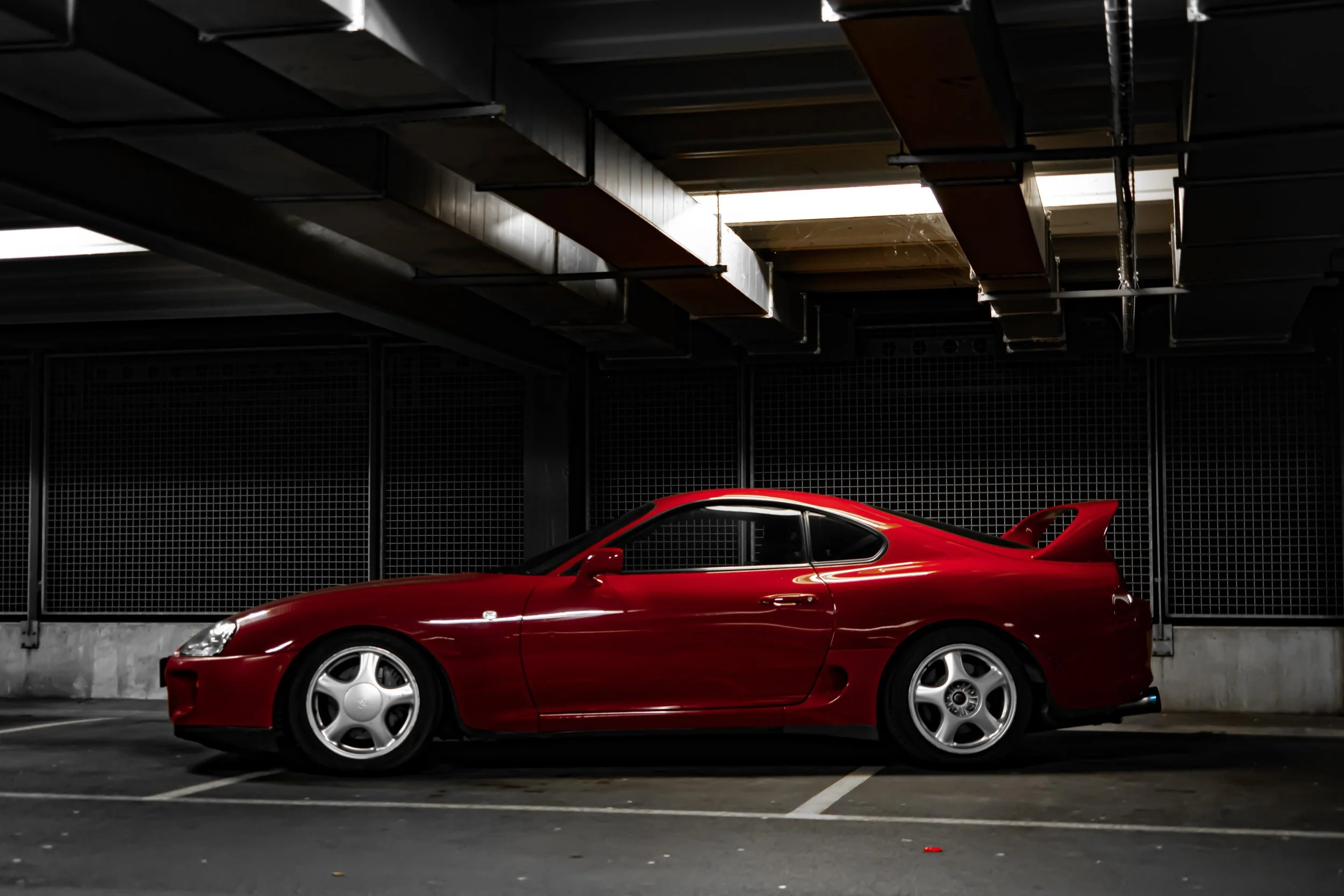
The 2JZ-GTE Changed Everything
The A80 Supra's reputation is built almost entirely on one engine: the 2JZ-GTE. A 3.0L cast-iron block inline-six with a forged crankshaft, forged connecting rods, and enough headroom in the bottom end to make 600–700 PS on stock internals with the right supporting modifications. It was overbuilt by design — Toyota engineers built in margins that tuners have been exploiting for 30 years and still haven't fully exhausted.
The JDM version is meaningfully different from the US and European spec cars. Where export markets got parallel twin turbos for immediate boost response, the JDM 2JZ-GTE used a sequential twin-turbo setup — one small ceramic CT20 turbo for low-rpm response, the second spooling in above 4,000 rpm for top-end power. This gives the JDM car a different torque characteristic and the ceramic turbines spool faster due to their lower mass.
- Cast iron block with forged internals — built to survive power levels Toyota never intended
- Sequential twin turbos on JDM spec — ceramic CT20 turbines, unique to the Japanese market
- 600–700 PS on stock bottom end with supporting mods — documented repeatedly
- Double wishbone suspension all around — the same geometry shared with the Z30 Soarer
- JDM production ran through August 2002 — four years longer than the US market
Which Supra to Buy
The JDM A80 came in three trim levels. The RZ is the one most enthusiasts are after — turbo, manual, LSD standard. The GZ is the luxury automatic flagship. The SZ and SZ-R are the naturally aspirated options, the latter gaining a 6-speed later in production.
| Trim | Engine | Transmission | Notes |
|---|---|---|---|
| RZ | 2JZ-GTE turbo | V160/V161 6-spd manual or 4-spd auto | The performance spec. LSD standard on manual. Bilstein suspension. The one to buy. |
| RZ-S | 2JZ-GTE turbo + VVT-i | V161 6-spd manual | Late production (1997+). VVT-i added, REAS suspension. Final and most refined turbo spec. |
| GZ | 2JZ-GTE turbo | 4-spd automatic only | Top luxury grade. Leather, cruise, active front spoiler. Auto only — less desirable to performance buyers. |
| SZ-R | 2JZ-GE NA | V161 6-spd manual | Naturally aspirated with the 6-speed. 220 PS. Lower entry cost — popular turbo swap candidate. |
| SZ | 2JZ-GE NA | 5-spd manual or auto | Base NA spec. Least desirable to collectors but mechanically identical block to the GTE. |
The 2JZ Family in the Supra
- 3.0L DOHC 24v sequential twin-turbo inline-six
- 280 PS / 435 Nm @ 3,600 rpm (pre-VVT-i)
- 280 PS / 451 Nm with VVT-i (RZ-S, 1997+)
- Cast iron block, forged crank and rods
- Ceramic CT20 sequential turbos — JDM specific
- Stock bottom end holds 600–700 PS with supporting mods
- Redline: 6,800 rpm
- 3.0L DOHC 24v naturally aspirated inline-six
- 220 PS / 285 Nm
- Same block architecture as the GTE
- SZ-R: V161 6-speed manual — same gearbox as turbo cars
- Popular turbo swap candidate — identical mounting points
- Lower purchase price than RZ equivalents
What It's Actually Like
The A80 Supra is a genuine grand touring car that happens to have extraordinary performance potential. The power delivery from the sequential turbo setup is different to a single turbo — smooth and progressive up to 4,000 rpm as the primary turbo works, then a noticeable secondary surge as the second turbo comes online. The 6-speed manual has a direct, mechanical action that remains one of the better JDM gearboxes of its era.
- Sequential turbo delivery — progressive rather than a sudden hit of boost
- V160/V161 6-speed is precise and well-weighted — a strong manual
- Double wishbone suspension — composed, planted, well-balanced
- Wide body, long wheelbase — stable at speed, more GT than sports car in character
- Optional targa roof (Aerotop) on automatic GZ and SZ models — adds open-air driving to the package
What They're Selling For
Supra values have climbed significantly over the past decade and show no signs of reversing. Clean manual turbo examples now command collector car prices. Budget accordingly — this is no longer an affordable performance car.
| Condition Tier | Price Range |
|---|---|
| Driver QualityHigher mileage, some wear, running well | $45,000 – $60,000 |
| Clean ExamplesRZ manual, documented, good condition | $60,000 – $90,000 |
| Low-Mileage / CollectorsUnmolested, exceptional provenance | $100,000+ |
Importing a Supra
All A80 Supras (1993–2002) are now eligible under the 25-year federal import rule. The JDM cars ran four years longer than the US market, meaning late-production 2001–2002 cars with VVT-i are now coming into eligibility. Import duty in the US is 2.5% of declared vehicle value. Budget for these costs on top of the purchase price:
Know Before You Buy
The 2JZ block is famously durable but the Supra is 25–30 years old. Age, modifications, and hard use create issues independent of the engine's inherent strength.
Rubber vacuum lines, boost hoses, and turbo seals crack with age. On a 30-year-old car this is expected maintenance — budget for a full hose refresh. A non-functioning secondary turbo shows up as a power drop above 4,000 rpm.
Most Supras have been modified. This isn't inherently a problem — but poorly done mods are. Verify who did the work, what was changed, and whether supporting mods (fuel, cooling, ECU) matched the power level. Turbo upgrades without proper fuel and tune can damage a stock bottom end.
Dash panels, trim pieces, and climate control units from this era fade and crack. OEM replacement parts are increasingly scarce. Condition varies widely — inspect carefully on any example.
The 2JZ uses a timing belt, not a chain. Toyota recommends replacement every 60,000 miles. Verify service history — a belt failure at high rpm is catastrophic. Always replace the water pump at the same time.
The Aftermarket Is Enormous
The Supra has one of the deepest aftermarket ecosystems of any Japanese car ever built. Thirty years of global tuning culture means parts, knowledge, and support are available at every level from stock restoration to four-digit horsepower builds.
- Single turbo conversions — the most common first major mod; well-documented kits available
- Coilover kits — vast selection; direct fit from every major suspension manufacturer
- Big brake kits — four-pot front, two-pot rear is standard from 1995; upgrades readily available
- ECU tuning — standalone systems (Haltech, AEM, Link) or piggyback; well-mapped territory
- Fuel system upgrades — required above 400 PS; widely available and well understood
- 2JZ-GTE — one of the strongest production engines ever built
- Sequential twin turbos unique to JDM spec
- Values rising consistently — strong collector trajectory
- 30 years of aftermarket development behind it